
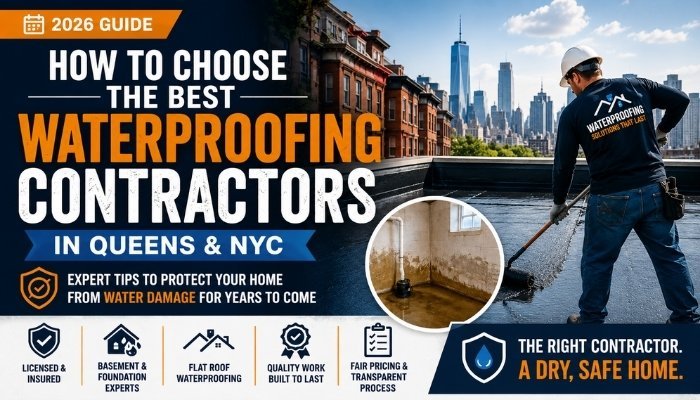
Why Waterproofing Matters in NYC: More Than Just Wet Floors
Water damage in New York City isn’t a minor inconvenience—it’s a structural emergency. Whether you own a historic brownstone in Brooklyn, a Queens rental property, or a modern Manhattan apartment, water infiltration can lead to foundation failure, mold contamination, and costly repairs that spiral into five or six figures.
The problem? When you search “waterproofing contractors near me,” you’ll find hundreds of options. But 80% of homeowners choose the wrong contractor, leading to repeat leaks, warranty disputes, and wasted money.
This guide walks you through the exact framework we use at Brick Pointing NYC to vet contractors—and what to look for when protecting your most valuable asset.
1. Verify NYC Licensing & Insurance (Non-Negotiable)
Before a contractor sets foot on your property, they must provide documented proof of:
Essential Credentials:
- NYC Department of Consumer and Worker Protection (DCWP) License – Required for any residential work in all five boroughs. Verify the license number on the NYC DCWP website.
- General Liability Insurance ($1M minimum) – Protects you if a contractor damages your property during waterproofing, masonry, or excavation work.
- Workers’ Compensation Insurance – Non-negotiable. If a worker is injured on your property and the contractor is uninsured, you’re legally liable.
- Bonding – A performance bond ensures they complete the job or you’re reimbursed.
Pro Tip: Request a hard copy of the insurance certificate before work begins. Call the insurance company directly to verify the policy is active—scammers sometimes submit expired documentation.
Red Flag: Any contractor who says “licensing is expensive” or “we work under another company’s license” should be immediately disqualified.
2. Understand NYC’s Unique Architecture & Climate Challenges
This is where most contractors fail. NYC’s waterproofing needs are completely different from the rest of the country.
Brownstone & Historic Masonry Buildings
- Problem: 100+ year old brick is porous. Apply modern rubber sealants and moisture gets trapped inside the brick, causing spalling (brick face crumbles off).
- Solution: “Breathable” waterproofing membranes that allow water vapor to escape while blocking liquid water. Your contractor should understand vapor permeability ratings.
- Why it matters: Incorrect waterproofing on a brownstone can destroy $50K+ in masonry in 5 years.
Flat Roof Systems (Common in Queens & Brooklyn)
- NYC’s freeze-thaw cycles are brutal. Water expands when frozen, creating cracks.
- Contractors must use modified bitumen or liquid-applied elastomeric membranes rated for the Northeast.
- Single-ply membranes often fail in NYC’s temperature swings.
High Groundwater Tables
- South Brooklyn, parts of Queens, and waterfront areas have rising groundwater.
- Requires external foundation sump systems, French drains, and perimeter waterproofing—not just interior sealants.
- Interior-only waterproofing is a band-aid solution in these areas.
Building Code Compliance
- NYC Building Code Section 3.2 requires specific waterproofing standards for basements below grade.
- Your contractor must be familiar with NYC Department of Buildings (DOB) requirements or risk failed inspections.
Question to ask: “What’s your experience with [your specific building type] in [your zip code]? Can you explain the waterproofing strategy for our climate?”
A qualified contractor will discuss vapor pressure, hydrostatic pressure, and material selection—not just “we’ll seal it.”
3. Prioritize Local Reputation & Verifiable Experience
Longevity in NYC Market
- 10+ years in NYC = credible. A contractor who survived ten winters has dealt with foundation failures, ice dam damage, and everything in between.
- Less than 3 years = high risk. They haven’t weathered a major disaster or handled warranty callbacks.
Local Project Portfolio
Request a portfolio of completed projects in your borough and building type. Relevant examples include:
- Basement waterproofing in your neighborhood
- Masonry restoration on similar-era buildings
- Flat roof sealing in the same zip code
- Foundation repairs after flooding
What to look for:
- Before/after photos with clear details
- Project timelines and budgets
- Specific materials used and why
- Long-term follow-up (did the repair last 5+ years?)
Red Flag: A contractor who shows only projects from New Jersey or Westchester is learning on your dime.
Reviews: Look Beyond Star Ratings
Check Google, Yelp, and Angie’s List for 2025-2026 reviews (ignore anything older). Read for these specific details:
Quality indicators in reviews:
- “Crew was clean and communicated daily” → Good project management
- “Fixed the leak and it stayed fixed 2+ years” → Actual problem-solving, not temporary patches
- “Respected the historic nature of our brownstone” → They understand specialized techniques
- “Explained the work and warranty clearly” → Transparent
Red flags in reviews:
- “Leak came back within 6 months” → Poor workmanship or wrong diagnosis
- “Wouldn’t return calls about warranty issues” → Abandon-ship behavior
- “We weren’t allowed in to watch the work” → Hiding poor technique
- “Much more expensive than quoted” → Hidden costs or scope creep games
Pro Move: Call 3-5 references directly. Ask: “Did the waterproofing actually solve the problem? How long have you had the fix? Would you hire them again?”
4. Get Multiple Inspections & Diagnoses (Critical)
This separates amateurs from experts.
What a professional inspection includes:
- Visual assessment of water entry points (external, not just internal damage)
- Moisture meter readings to map water saturation
- Thermal imaging to identify hidden moisture
- Hydrostatic pressure testing (for basements)
- Assessment of drainage systems and grading
- Photos with detailed notes
Red Flag: If a contractor quotes a price without conducting a thorough inspection, they’re guessing.
Multiple bids should reveal: If three contractors give three different diagnoses, one of them is wrong. Ask each contractor to explain their findings. The most credible one will identify root causes, not just symptoms.
Example:
- Bad contractor: “Your basement leaks. We’ll seal it for $5,000.”
- Good contractor: “Your foundation has hydrostatic pressure from groundwater. Your external drainage is blocked. We recommend sump installation + perimeter waterproofing + interior sealing. $15,000. Here’s why each step matters.”
5. Warranty & Guarantees (Read the Fine Print)
- Reputable contractors offer 5-10 year warranties on waterproofing work.
- Get it in writing. Verbal promises are worthless.
- Understand what’s covered: labor, materials, re-service, or just parts replacement?
- Check the conditions: Many warranties are void if you don’t maintain exterior drainage systems.
Example of weak warranty:
“We guarantee the sealant won’t fail for 5 years. Warranty void if water enters from other sources.” (Too many loopholes.)
Example of strong warranty:
“We guarantee your basement stays dry for 10 years from the date of completion. If water enters through the area we waterproofed, we’ll return at no charge to fix it. Warranty covers labor and materials.”
6. Communication & Project Management
Before hiring, observe how the contractor communicates:
- Do they return calls/emails within 24 hours?
- Do they answer questions in detail or brush you off?
- Do they provide a detailed written contract with timeline and scope?
- Will they explain the work in terms you understand?
During the project:
- Expect daily updates from the site manager
- They should protect your home (plastic sheeting, dust containment)
- The work area should be cleaned daily
- They should respect your space and schedule
7. Pricing: Red Flags & Reality Check
Suspiciously low bids (20-30% cheaper) usually mean:
- They’re cutting corners (cheap materials, skipping steps)
- They don’t understand the job’s complexity
- They’ll disappear if problems arise
Suspiciously high bids (2x the average) might be justified if:
- They’re dealing with difficult access or contamination
- They’re offering premium materials or longer warranties
- They include detailed site remediation
Realistic pricing in NYC (2026):
- Basement waterproofing: $8,000-$25,000 (depends on size and method)
- Flat roof sealing: $4-$8 per square foot
- Foundation repair: $10,000-$40,000
- Brownstone masonry work: $15,000-$50,000+
Get 3 bids. If they vary wildly, ask why.
8. Contractor Selection Checklist
Use this before signing any contract:
☐ NYC DCWP License verified (online check)
☐ General Liability Insurance confirmed ($1M+)
☐ Workers' Comp Insurance verified
☐ 10+ years operating in NYC
☐ Local portfolio with relevant projects
☐ Recent reviews (2025-2026) mention quality & longevity
☐ Called 3+ references directly
☐ Detailed inspection and written diagnosis provided
☐ Written proposal with scope, timeline, price breakdown
☐ 5+ year warranty in writing
☐ Good communication during estimate process
☐ Price is competitive (not lowest, not highest)
The Bottom Line: Protect Your Investment
A $10,000 waterproofing job done correctly lasts 10+ years. A $5,000 band-aid solution costs you $10,000 more in a year when the leak returns and mold sets in.
The contractor you choose matters. Use this guide to hire someone who understands NYC’s unique challenges, communicates transparently, and stands behind their work.
Your home’s structural integrity depends on it.